

Remote sites are mission‑critical assets, yet they operate across diverse operational domains — power and energy systems, RF, radio, and cellular infrastructure, thermal and environmental controls, physical security, IP networking, compute and storage platforms, and backhaul transport — each presenting unique failure conditions that can disrupt service, increase OPEX, and impact customer experience if not managed in real time.
Most organizations rely on a patchwork of siloed tools, vendor‑specific interfaces, and delayed notifications that make it difficult to maintain situational awareness, prioritize issues, or respond before service is impacted.
This fragmentation increases downtime, drives up OPEX, and forces Operations teams to work reactively instead of proactively. Problems that should be detected early — voltage drops, over‑current conditions, RF or cellular degradation, thermal spikes, fuel anomalies, unauthorized access — often go unnoticed until they escalate into outages, unplanned site visits, or broader service disruptions that affect operational performance and customer experience.
ComView addresses these challenges by unifying real‑time intelligence across all remote‑site domains. Edge gateways analyze conditions locally, detect failure states the moment they occur, and normalize data from diverse equipment, vendors, and protocols. This eliminates the complexity of managing multiple tools and reduces the dependency on specialized expertise at the Operations Center. ARC extends this capability by providing centralized alarm awareness without configuration or auto‑discovery, ensuring that every critical event is surfaced immediately and consistently across the entire network.
For Operations management, this unified approach delivers both technical and commercial advantages. It reduces the operational burden of managing multiple tools, standardizes monitoring practices across all sites, and ensures that critical failure conditions are detected and acted on immediately. Teams gain a clearer operational picture, faster decision cycles, and fewer unplanned site visits — all of which translate into lower OPEX, improved service reliability, and a more resilient remote‑site footprint. ComView provides a scalable foundation that supports growth, simplifies operations, and strengthens the organization’s ability to maintain high service levels across diverse and distributed environments.
Most organizations rely on a patchwork of siloed tools, vendor‑specific interfaces, and delayed notifications that make it difficult to maintain situational awareness, prioritize issues, or respond before service is impacted.
This fragmentation increases downtime, drives up OPEX, and forces Operations teams to work reactively instead of proactively. Problems that should be detected early — voltage drops, over‑current conditions, RF or cellular degradation, thermal spikes, fuel anomalies, unauthorized access — often go unnoticed until they escalate into outages, unplanned site visits, or broader service disruptions that affect operational performance and customer experience.
ComView addresses these challenges by unifying real‑time intelligence across all remote‑site domains. Edge gateways analyze conditions locally, detect failure states the moment they occur, and normalize data from diverse equipment, vendors, and protocols. This eliminates the complexity of managing multiple tools and reduces the dependency on specialized expertise at the Operations Center. ARC extends this capability by providing centralized alarm awareness without configuration or auto‑discovery, ensuring that every critical event is surfaced immediately and consistently across the entire network.
For Operations management, this unified approach delivers both technical and commercial advantages. It reduces the operational burden of managing multiple tools, standardizes monitoring practices across all sites, and ensures that critical failure conditions are detected and acted on immediately. Teams gain a clearer operational picture, faster decision cycles, and fewer unplanned site visits — all of which translate into lower OPEX, improved service reliability, and a more resilient remote‑site footprint. ComView provides a scalable foundation that supports growth, simplifies operations, and strengthens the organization’s ability to maintain high service levels across diverse and distributed environments.
Operational Consolidation & Vendor Silo Elimination
unify every onsite domain into one intelligent platform
The Challenge — The “Swivel‑Chair” Complexity of Disparate Systems
Across remote and distributed sites, Operations teams often rely on a patchwork of specialized tools — one for power, another for environmental data, another for security, and yet another for IT or server access. Resolving a single issue can require switching between multiple platforms, each with its own interface, alarm format, and workflow.
This fragmentation creates significant operational friction:
Across remote and distributed sites, Operations teams often rely on a patchwork of specialized tools — one for power, another for environmental data, another for security, and yet another for IT or server access. Resolving a single issue can require switching between multiple platforms, each with its own interface, alarm format, and workflow.
This fragmentation creates significant operational friction:
- Data Fatigue — Teams must navigate inconsistent interfaces, multiple credentials, and incompatible alarm formats
- Delayed Response — Time is lost correlating information across disconnected systems to identify the root cause of a failure
- Hidden OPEX Costs — Multiple vendor licenses, separate training requirements, and parallel maintenance contracts inflate operational expenses
- Visibility Gaps — Integrating legacy equipment with modern systems often results in blind spots that leave critical issues undetected
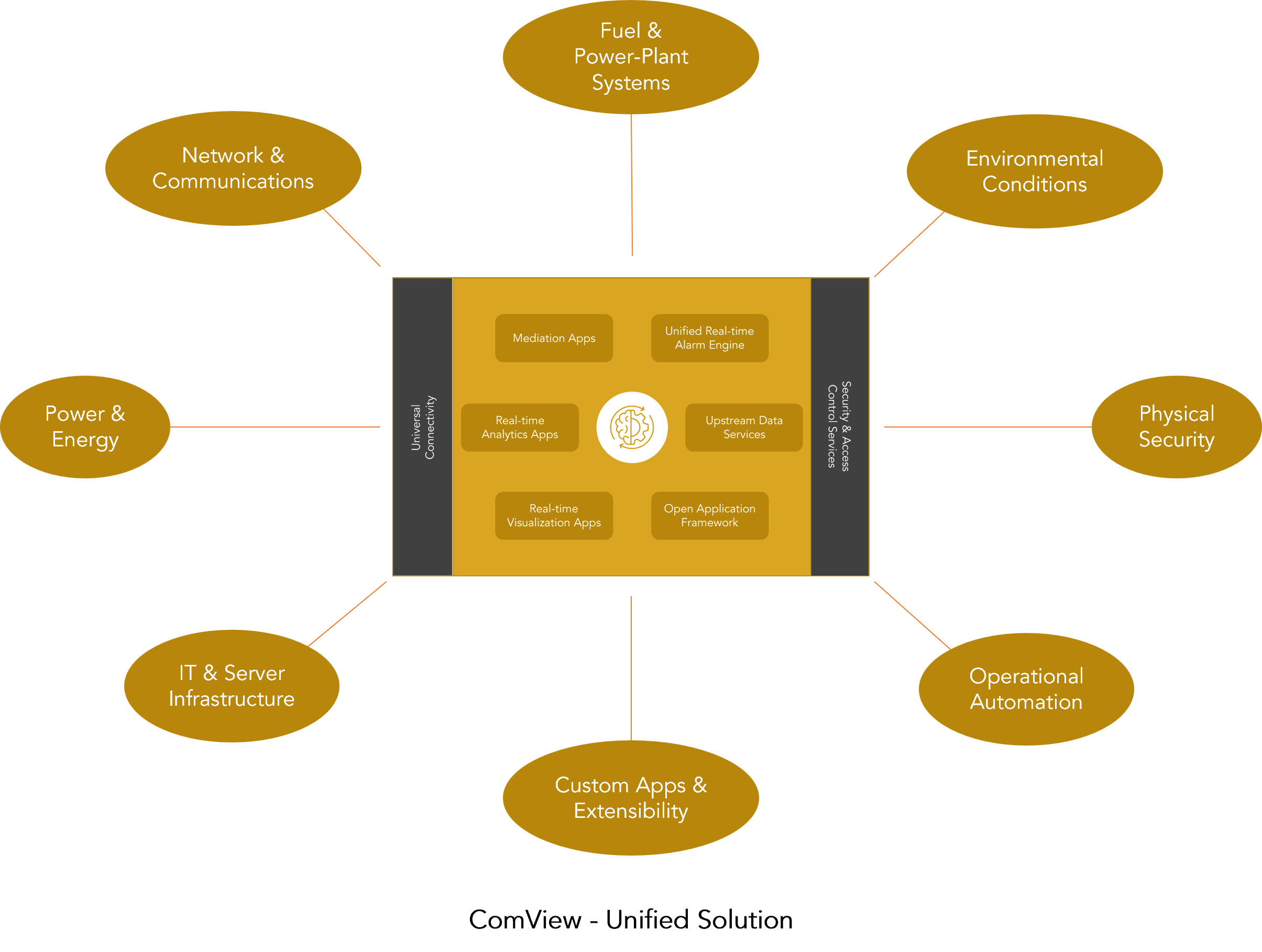
The ComView Solution — One Platform. Total Visibility.
ComView eliminates fragmented monitoring by acting as a unified operational intelligence platform that adapts to virtually any onsite requirement. Whether the need is power, environmental, IT, security, or application‑level monitoring, ComView consolidates these domains into a single, software‑defined environment.
1). Universal Mediation Across Onsite Systems
ComView’s platform architecture allows it to interface with nearly any onsite system — legacy or modern — and normalize diverse data into a consistent, actionable model. This enables teams to view all operational domains through a unified lens without juggling multiple tools.
2). Consolidated Alarm Engine
Instead of managing separate notification systems, ComView processes all onsite events through a single alarm engine. Alarms are standardized, prioritized, and delivered in a consistent format, enabling faster triage and more confident decision‑making.
3). Unified Operational Workflow
From checking power conditions to reviewing environmental data to accessing a remote server console, all actions occur within the same ComView environment. This eliminates the “swivel‑chair” workflow and streamlines day‑to‑day operations.
4). Modular Extensibility for Evolving Requirements
As site requirements change, ComView evolves with them. New capabilities can be added simply by activating additional ComView application modules — no new platforms, no new vendors, and no disruptive system replacements. This ensures long‑term adaptability and protects your investment.
ComView eliminates fragmented monitoring by acting as a unified operational intelligence platform that adapts to virtually any onsite requirement. Whether the need is power, environmental, IT, security, or application‑level monitoring, ComView consolidates these domains into a single, software‑defined environment.
1). Universal Mediation Across Onsite Systems
ComView’s platform architecture allows it to interface with nearly any onsite system — legacy or modern — and normalize diverse data into a consistent, actionable model. This enables teams to view all operational domains through a unified lens without juggling multiple tools.
2). Consolidated Alarm Engine
Instead of managing separate notification systems, ComView processes all onsite events through a single alarm engine. Alarms are standardized, prioritized, and delivered in a consistent format, enabling faster triage and more confident decision‑making.
3). Unified Operational Workflow
From checking power conditions to reviewing environmental data to accessing a remote server console, all actions occur within the same ComView environment. This eliminates the “swivel‑chair” workflow and streamlines day‑to‑day operations.
4). Modular Extensibility for Evolving Requirements
As site requirements change, ComView evolves with them. New capabilities can be added simply by activating additional ComView application modules — no new platforms, no new vendors, and no disruptive system replacements. This ensures long‑term adaptability and protects your investment.
The Results — Lower OPEX, Higher Efficiency, and Complete Operational Clarity
By consolidating monitoring and management onto a single platform, ComView transforms how organizations operate their remote and distributed sites:
By consolidating monitoring and management onto a single platform, ComView transforms how organizations operate their remote and distributed sites:
- Significant OPEX Reduction — Fewer licenses, fewer vendors, and fewer systems to maintain
- Faster MTTR — Unified data at the edge enables rapid diagnosis and quicker restoration of service
- Simplified Training — Teams learn one system instead of mastering multiple vendor‑specific tools
- Operational Sovereignty — Organizations regain control of their data and workflows without being locked into proprietary ecosystems
- Consistent Visibility Across All Sites — Every domain, every system, and every event is visible through one platform
Who It’s For
ComView’s operational consolidation capabilities are designed for organizations that manage diverse, distributed, or multi‑vendor environments and need a unified way to monitor and control their remote sites. This solution is ideal for teams responsible for:
ComView is built for IT, Operations, Engineering, and Infrastructure teams who need consistent visibility, faster response, and lower OPEX across all their remote and distributed environments.
ComView’s operational consolidation capabilities are designed for organizations that manage diverse, distributed, or multi‑vendor environments and need a unified way to monitor and control their remote sites. This solution is ideal for teams responsible for:
- Edge IT Sites across corporate branches, field offices, and distributed operations
- Remote corporate IT rooms supporting servers, network equipment, and critical applications
- Micro data centers and edge compute rooms in retail, finance, healthcare, and logistics
- Industrial and utility operations sites with mixed‑vendor infrastructure
- Transportation and public‑safety facilities requiring unified visibility across power, IT, and environmental systems
- Telecom, RF, and cellular support sites with legacy and modern equipment
- Any organization seeking to eliminate vendor silos and consolidate monitoring into a single operational platform
ComView is built for IT, Operations, Engineering, and Infrastructure teams who need consistent visibility, faster response, and lower OPEX across all their remote and distributed environments.
Mediation & Intelligence Platform for Managed Service Providers
unify client environments, scale service offerings, and deliver consistent visibility across every site
The Challenge — Diverse Client Environments, Inconsistent Tools, and Rising Operational Burden
Managed Service Providers (MSPs) face the same operational pressures as corporate Operations teams — but multiplied across many clients, each with its own mix of equipment, vendors, legacy systems, and evolving requirements. Supporting these environments often means juggling multiple monitoring tools, inconsistent alarm formats, proprietary vendor ecosystems, and custom integrations that must be maintained over time.
This fragmentation creates significant challenges:
Managed Service Providers (MSPs) face the same operational pressures as corporate Operations teams — but multiplied across many clients, each with its own mix of equipment, vendors, legacy systems, and evolving requirements. Supporting these environments often means juggling multiple monitoring tools, inconsistent alarm formats, proprietary vendor ecosystems, and custom integrations that must be maintained over time.
This fragmentation creates significant challenges:
- Inconsistent Visibility — Each client site may require a different toolset, making it difficult to maintain a unified operational workflow
- High Integration Overhead — MSPs must constantly adapt to new client requirements, new device types, and new vendor technologies
- Slow Onboarding — Bringing a new client into the MSP’s monitoring ecosystem often requires custom engineering or manual configuration
- Limited Scalability — Supporting diverse infrastructures with disparate tools increases operational cost and reduces service agility
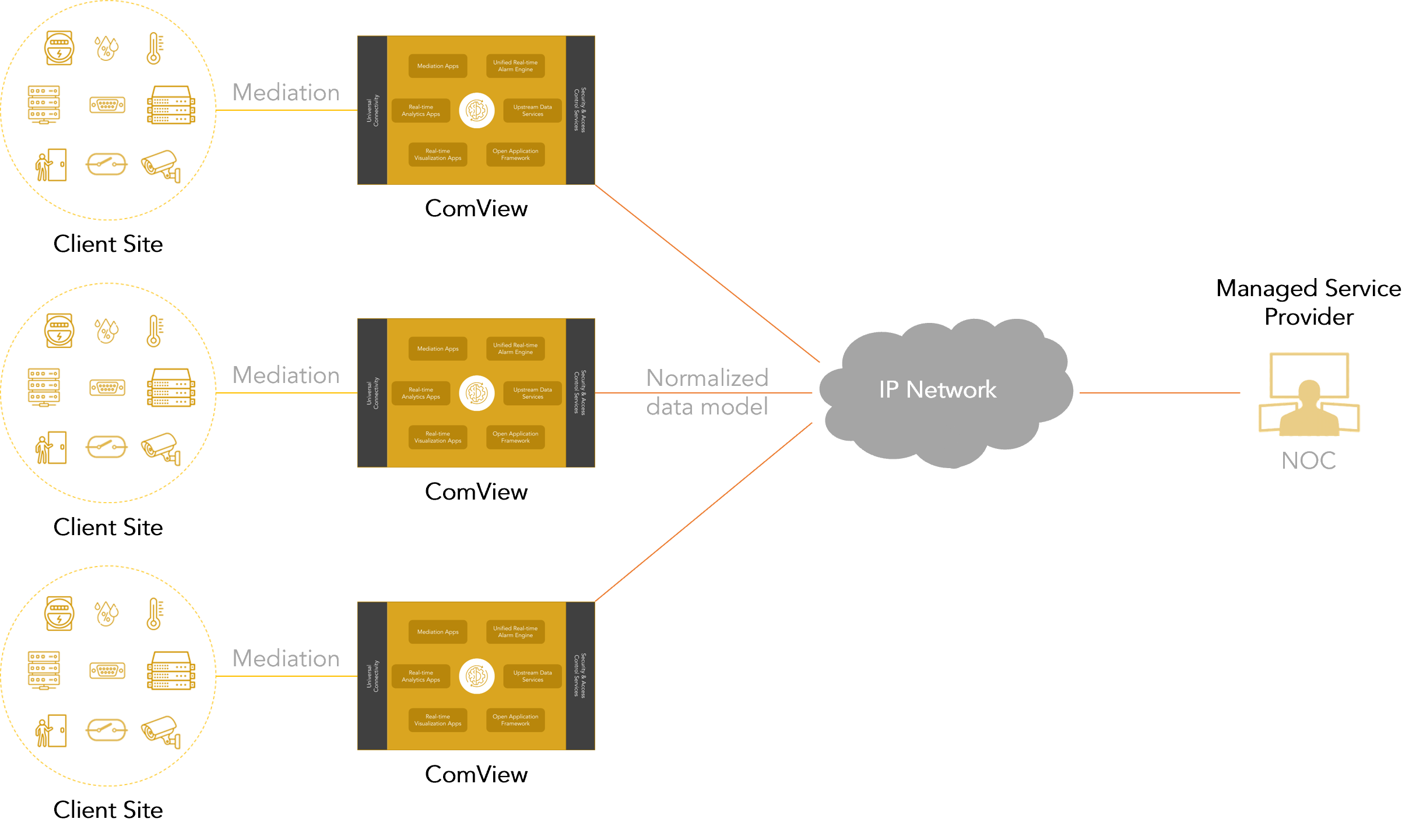
The ComView Solution — One Platform for All Clients
ComView provides MSPs with a unified mediation and intelligence platform that simplifies onboarding, standardizes visibility, and enables scalable service delivery across mixed‑vendor environments.
1). Universal Mediation Across Any Onsite Domain
ComView mediates with virtually any onsite system — power, environmental, IT, network, security, or application‑level — and normalizes all data and alarms into a unified operational model.
This eliminates the complexity of dealing with inconsistent vendor formats, proprietary ecosystems, or custom integrations for each client.
2). Extensible Platform for Evolving Client Requirements
As MSPs onboard new clients or encounter new monitoring needs, ComView evolves with them.
The platform supports modular application extensions, allowing MSPs to activate new capabilities or add new domain‑specific apps without replacing tools or redesigning workflows.
This lowers the technical barrier to securing new clients and enables MSPs to expand their service offerings without constraint.
3). Simplified Upstream Integration via SNMP, MQTT, and CSV‑Formatted Data
ComView delivers standardized, normalized intelligence that integrates seamlessly with the management platforms used by MSPs. By transmitting application data and alarms through SNMP, MQTT, and structured CSV‑formatted records, ComView removes the complexity of dealing with inconsistent vendor formats or proprietary ecosystems. MSPs can onboard new client sites quickly, maintain consistent visibility across mixed‑vendor infrastructures, and expand their service offerings simply by activating new ComView application modules. ComView becomes the scalable foundation that reduces integration overhead and enables service providers to deliver higher‑value services with confidence.
ComView provides MSPs with a unified mediation and intelligence platform that simplifies onboarding, standardizes visibility, and enables scalable service delivery across mixed‑vendor environments.
1). Universal Mediation Across Any Onsite Domain
ComView mediates with virtually any onsite system — power, environmental, IT, network, security, or application‑level — and normalizes all data and alarms into a unified operational model.
This eliminates the complexity of dealing with inconsistent vendor formats, proprietary ecosystems, or custom integrations for each client.
2). Extensible Platform for Evolving Client Requirements
As MSPs onboard new clients or encounter new monitoring needs, ComView evolves with them.
The platform supports modular application extensions, allowing MSPs to activate new capabilities or add new domain‑specific apps without replacing tools or redesigning workflows.
This lowers the technical barrier to securing new clients and enables MSPs to expand their service offerings without constraint.
3). Simplified Upstream Integration via SNMP, MQTT, and CSV‑Formatted Data
ComView delivers standardized, normalized intelligence that integrates seamlessly with the management platforms used by MSPs. By transmitting application data and alarms through SNMP, MQTT, and structured CSV‑formatted records, ComView removes the complexity of dealing with inconsistent vendor formats or proprietary ecosystems. MSPs can onboard new client sites quickly, maintain consistent visibility across mixed‑vendor infrastructures, and expand their service offerings simply by activating new ComView application modules. ComView becomes the scalable foundation that reduces integration overhead and enables service providers to deliver higher‑value services with confidence.
The Results — Scalable Services, Lower Overhead, and Higher Client Value
By consolidating client monitoring into a single platform, MSPs gain:
ComView empowers MSPs to deliver enterprise‑grade monitoring and operational intelligence at scale — without the complexity traditionally associated with multi‑client environments.
By consolidating client monitoring into a single platform, MSPs gain:
- Faster onboarding with minimal integration effort
- Lower operational overhead by eliminating multiple vendor tools
- Consistent workflows across all client environments
- Higher service reliability through unified alarms and normalized data
- Greater agility to meet evolving client requirements
- Stronger commercial positioning with a platform that adapts to any client site
ComView empowers MSPs to deliver enterprise‑grade monitoring and operational intelligence at scale — without the complexity traditionally associated with multi‑client environments.
Who It’s For
This solution is designed for:
ComView gives MSPs and Operations teams the same advantage: a single, extensible platform that unifies all domains, simplifies workflows, and delivers consistent visibility across every site they support.
This solution is designed for:
- Managed Service Providers (MSPs) supporting diverse client infrastructures
- Network Operations Centers (NOCs) managing multi‑vendor or multi‑client environments
- IT outsourcing firms delivering remote monitoring and management services
- Corporate Operations teams responsible for distributed sites across business units
- Organizations with mixed‑vendor or legacy equipment seeking unified visibility
- Service providers expanding into new industries with evolving monitoring requirements
ComView gives MSPs and Operations teams the same advantage: a single, extensible platform that unifies all domains, simplifies workflows, and delivers consistent visibility across every site they support.
Dispatch System & Mission‑Critical Infrastructure Monitoring
monitoring RXoIP servers, consoles, and audio recorders in real time
The Challenge — Silent Failures in the Dispatch Core
In public safety, utilities, and transportation operations, the Radio Dispatch Center is the command point for mission‑critical communications. Modern RXoIP (Radio over IP) architectures depend on a tightly coordinated ecosystem of servers, consoles, and audio recorders — each running multiple software services and each capable of failing silently. A stalled recorder process, an overloaded CPU, a service crash, or a disk‑space issue can compromise communications, disrupt dispatch workflows, or result in missing audio evidence required for investigations, audits, or legal proceedings.
These failures often develop quietly. A recorder may stop logging, a service may stall, CPU or memory usage may spike, or disk capacity may begin to run low — all early indicators of conditions that can compromise communications or disrupt dispatch workflows. Because these issues can occur at the service level rather than the system level, they frequently go unnoticed until dispatchers experience audio problems, missing recordings, or delayed responses. By the time symptoms surface, service continuity has already been affected, and Operations teams are forced into reactive recovery.
In public safety, utilities, and transportation operations, the Radio Dispatch Center is the command point for mission‑critical communications. Modern RXoIP (Radio over IP) architectures depend on a tightly coordinated ecosystem of servers, consoles, and audio recorders — each running multiple software services and each capable of failing silently. A stalled recorder process, an overloaded CPU, a service crash, or a disk‑space issue can compromise communications, disrupt dispatch workflows, or result in missing audio evidence required for investigations, audits, or legal proceedings.
These failures often develop quietly. A recorder may stop logging, a service may stall, CPU or memory usage may spike, or disk capacity may begin to run low — all early indicators of conditions that can compromise communications or disrupt dispatch workflows. Because these issues can occur at the service level rather than the system level, they frequently go unnoticed until dispatchers experience audio problems, missing recordings, or delayed responses. By the time symptoms surface, service continuity has already been affected, and Operations teams are forced into reactive recovery.
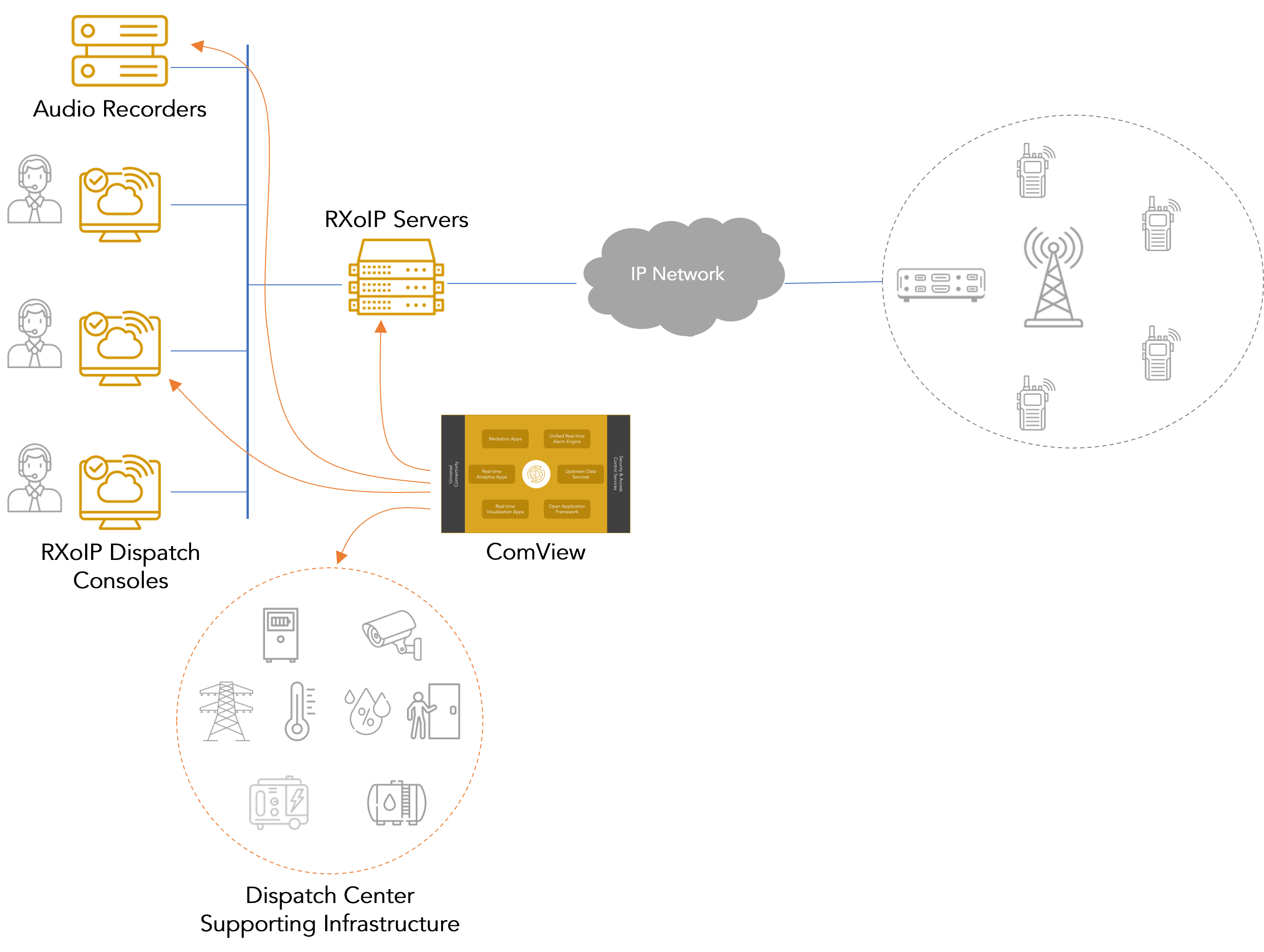
The ComView Solution — Real‑Time Visibility for RXoIP Ecosystems
ComView delivers a purpose‑built monitoring layer for dispatch centers, providing deep, real‑time intelligence across RXoIP servers, consoles, audio recorders, and supporting infrastructure. The solution proactively interacts with each system, detects service‑level conditions, and surfaces failure conditions the moment they occur.
1). RXoIP Server & Console Health Monitoring
ComView goes beyond basic server checks by monitoring the actual dispatch applications and services that keep communications running:
Audio recorders are essential for investigations, depositions, training, and operational reviews. ComView ensures recorder integrity is never left to chance:
ComView consolidates monitoring for all supporting systems — UPS, temperature, access security, and more — into one platform, eliminating the need for multiple tools and reducing operational complexity.
ComView delivers a purpose‑built monitoring layer for dispatch centers, providing deep, real‑time intelligence across RXoIP servers, consoles, audio recorders, and supporting infrastructure. The solution proactively interacts with each system, detects service‑level conditions, and surfaces failure conditions the moment they occur.
1). RXoIP Server & Console Health Monitoring
ComView goes beyond basic server checks by monitoring the actual dispatch applications and services that keep communications running:
- Service‑Level Monitoring — Continuous tracking of the running status of all critical RXoIP services
- Resource Intelligence — Real‑time CPU and memory usage for each RXoIP service, plus system‑level RAM and disk utilization
- Anomaly Detection — Statistical, self‑learned baselines identify abnormal resource consumption before it becomes a service outage
- Custom Thresholds — User‑defined alarm conditions for disk usage, with specific focus on ensuring sufficient free space for the SQL database to operate reliably and prevent service interruptions
Audio recorders are essential for investigations, depositions, training, and operational reviews. ComView ensures recorder integrity is never left to chance:
- Proactive Log Extraction — ComView polls recorder SNMP MIB and extracts log entries based on user‑defined severity levels (info, warning, critical, severe)
- Redundancy‑Aware Monitoring — Supports multiple recorders configured for failover or redundancy within the dispatch center
- Immediate Alarm Reporting — Sends alarms to ComView ARC, NOC/NMS platforms, enterprise systems, and cloud services
ComView consolidates monitoring for all supporting systems — UPS, temperature, access security, and more — into one platform, eliminating the need for multiple tools and reducing operational complexity.
The Results — Verified Continuity for Mission‑Critical Dispatch Operations
ComView transforms the dispatch environment from reactive troubleshooting to proactive operational control:
ComView transforms the dispatch environment from reactive troubleshooting to proactive operational control:
- Early detection of service stalls, resource exhaustion, and recorder failures
- Fewer unplanned site visits and reduced OPEX
- Improved dispatcher experience and communication reliability
- Assurance that all audio recordings are captured and preserved
- Standardized monitoring across servers, consoles, and recorders
- A single operational view through ComView ARC or enterprise NMS platforms
Who It’s For
- Public‑safety dispatch centers
- Utilities and energy control rooms
- Transportation and railway operations centers
- Industrial and mining communications hubs
- Municipal and regional emergency services
- Any organization relying on RXoIP‑based dispatch communications
RF Transmission Line & Performance Analytics
measuring & monitoring forward power, reflected power, and VSWR in real time
The Challenge — Invisible Degradation in Critical RF Infrastructure
RF coverage is the foundation of mission‑critical communications. At remote RF sites, multiple repeaters feed into a combiner and ultimately into the antenna system — a chain where any degradation can reduce coverage, distort audio, or cause complete loss of communication. Problems such as moisture ingress, connector corrosion, cable damage, or impedance mismatch often develop gradually and remain undetected.
Without real‑time visibility into forward power, reflected power, and VSWR, Operations teams are left reacting to user complaints or site outages rather than identifying early‑stage degradation. This lack of insight increases downtime, drives up OPEX, and exposes organizations to service interruptions that impact operational performance and user safety.
RF coverage is the foundation of mission‑critical communications. At remote RF sites, multiple repeaters feed into a combiner and ultimately into the antenna system — a chain where any degradation can reduce coverage, distort audio, or cause complete loss of communication. Problems such as moisture ingress, connector corrosion, cable damage, or impedance mismatch often develop gradually and remain undetected.
Without real‑time visibility into forward power, reflected power, and VSWR, Operations teams are left reacting to user complaints or site outages rather than identifying early‑stage degradation. This lack of insight increases downtime, drives up OPEX, and exposes organizations to service interruptions that impact operational performance and user safety.
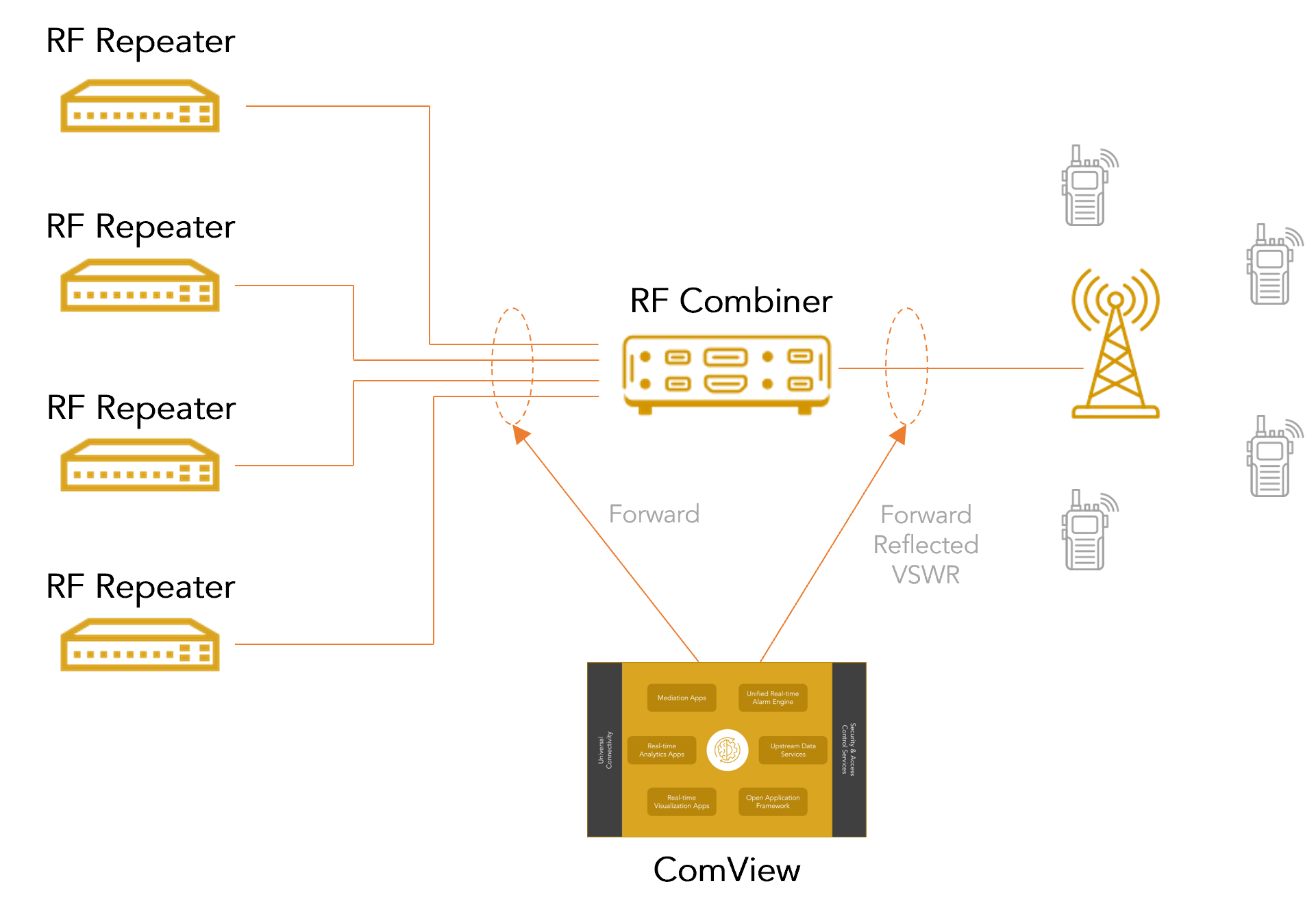
The ComView Solution — Real‑Time Edge Intelligence for RF Signal Paths
ComView provides a dedicated RF monitoring and analytics layer at the edge, delivering continuous visibility into the health and performance of the entire RF transmission line. By measuring RF power directly at the site and applying digital signal processing, ComView not only triggers real‑time alarms when thresholds are breached, but also generates performance analytics that allow users to visualize subtle degradation trends long before they become service‑impacting events.
1). Repeater‑Level Forward Power Monitoring
ComView monitors the forward transmit power from each RF repeater individually, ensuring that every transmitter is operating within user‑defined thresholds. This enables early detection of:
ComView continuously measures and monitors:
ComView applies digital filters to raw RF measurements to remove noise and transient spikes. This ensures:
All RF measurements are converted into CSV‑formatted performance records, enabling:
ComView monitors the RF transmission line around the clock, detecting issues in real time and enabling immediate corrective action to reduce service interruptions or system downtime.
ComView provides a dedicated RF monitoring and analytics layer at the edge, delivering continuous visibility into the health and performance of the entire RF transmission line. By measuring RF power directly at the site and applying digital signal processing, ComView not only triggers real‑time alarms when thresholds are breached, but also generates performance analytics that allow users to visualize subtle degradation trends long before they become service‑impacting events.
1). Repeater‑Level Forward Power Monitoring
ComView monitors the forward transmit power from each RF repeater individually, ensuring that every transmitter is operating within user‑defined thresholds. This enables early detection of:
- Power drops caused by repeater faults
- Amplifier degradation
- Misconfigured or failing RF paths
ComView continuously measures and monitors:
- Forward Power — to confirm expected transmit output
- Reflected Power — to detect impedance mismatch
- VSWR — to assess antenna system health
- Moisture ingress
- Damaged cables or connectors
- Combiner faults
- Antenna degradation
ComView applies digital filters to raw RF measurements to remove noise and transient spikes. This ensures:
- Fewer false alarms
- Higher confidence in detected anomalies
- More accurate trend analysis
All RF measurements are converted into CSV‑formatted performance records, enabling:
- Onsite analytics
- Long‑term trend analysis
- Upstream processing by enterprise systems or cloud applications
ComView monitors the RF transmission line around the clock, detecting issues in real time and enabling immediate corrective action to reduce service interruptions or system downtime.
The Results — Maximum Coverage, Minimum Downtime
ComView transforms RF site maintenance from reactive troubleshooting to proactive operational control:
ComView transforms RF site maintenance from reactive troubleshooting to proactive operational control:
- Early detection of RF degradation before coverage is affected
- Reduced downtime through proactive maintenance
- Improved coverage reliability for mission‑critical users
- Protection of expensive RF equipment from damage caused by high VSWR
- Fewer unplanned site visits, lowering OPEX
- Standardized RF monitoring across all sites
- High‑integrity analytics for engineering and performance teams
Who It’s For
- Public‑safety RF sites (police, fire, EMS)
- Utilities and energy communications networks
- Transportation and railway radio systems
- Industrial and mining RF infrastructure
- Municipal and regional radio networks
- Any organization operating RF repeaters, combiners, and antenna systems
Granular DC Power Systems Monitoring & Performance Analytics
monitoring DC power supplies & power distribution in real time
The Challenge — The Visibility Gap in Power Distribution
In mission‑critical RF and cellular sites, the DC power system is the backbone that keeps every onsite device operational — repeaters, combiners, routers, backhaul radios, environmental systems, and security infrastructure. Yet real‑world power issues often develop silently: unstable AC mains, drifting DC output levels, or a single port drawing abnormal current. Without granular visibility into system, bus, and port‑level behavior, these conditions go unnoticed until they escalate into equipment faults, service degradation, or unexpected outages.
AC mains may fluctuate, DC output can drift, or a single distribution port may begin drawing abnormal current — all early indicators of underlying electrical or equipment problems. Without visibility into how the power plant behaves at the system, bus, and port levels, these conditions remain hidden until they escalate into equipment faults, degraded RF performance, or unexpected service outages.
In mission‑critical RF and cellular sites, the DC power system is the backbone that keeps every onsite device operational — repeaters, combiners, routers, backhaul radios, environmental systems, and security infrastructure. Yet real‑world power issues often develop silently: unstable AC mains, drifting DC output levels, or a single port drawing abnormal current. Without granular visibility into system, bus, and port‑level behavior, these conditions go unnoticed until they escalate into equipment faults, service degradation, or unexpected outages.
AC mains may fluctuate, DC output can drift, or a single distribution port may begin drawing abnormal current — all early indicators of underlying electrical or equipment problems. Without visibility into how the power plant behaves at the system, bus, and port levels, these conditions remain hidden until they escalate into equipment faults, degraded RF performance, or unexpected service outages.
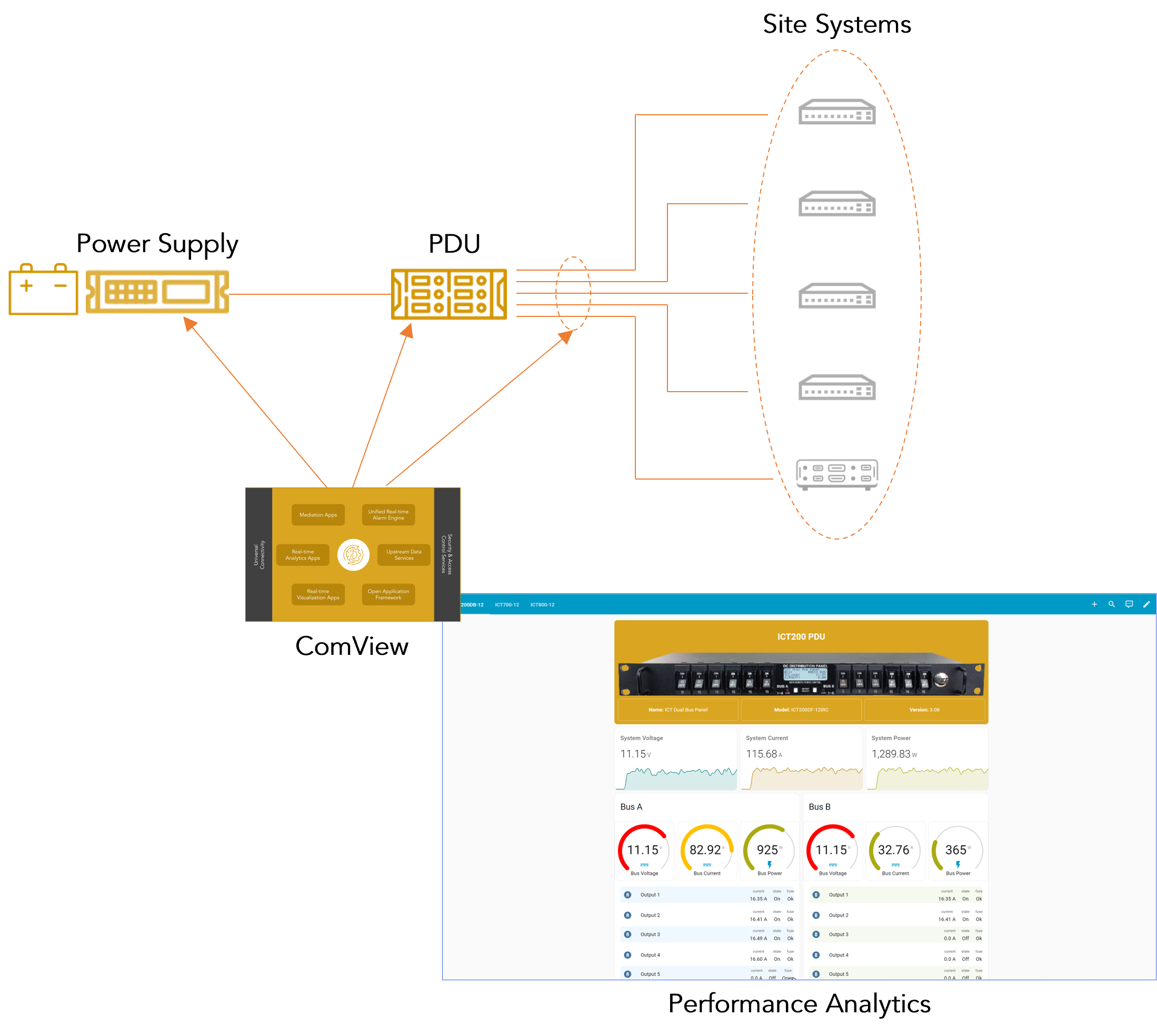
The ComView Solution — System, Bus, and Port‑Level Precision
ComView delivers a comprehensive DC power monitoring solution that treats the power plant as a collection of individual, mission‑critical components. By monitoring AC input, DC output, and per‑port distribution behavior, ComView provides the edge‑side intelligence needed to detect early degradation and prevent service‑impacting events.
1). DC Power Supply Monitoring
ComView continuously monitors:
2). PDU Monitoring
ComView provides deep insight into the DC distribution layer:
3). Power as a Diagnostic Tool
Because ComView monitors current draw at each port, it becomes a powerful diagnostic tool for the systems connected to the PDU:
4). Performance Analytics for Long‑Term Degradation Detection
Beyond real‑time alarms, ComView generates performance analytics that allow users to:
ComView delivers a comprehensive DC power monitoring solution that treats the power plant as a collection of individual, mission‑critical components. By monitoring AC input, DC output, and per‑port distribution behavior, ComView provides the edge‑side intelligence needed to detect early degradation and prevent service‑impacting events.
1). DC Power Supply Monitoring
ComView continuously monitors:
- AC mains presence and loss
- AC input voltage levels
- DC output voltage and current
- User‑defined over/under voltage and current thresholds
2). PDU Monitoring
ComView provides deep insight into the DC distribution layer:
- System‑level DC voltage and current
- Per‑port voltage and current monitoring
- Fuse/circuit breaker status for each output port
- User‑defined thresholds for over/under voltage and current conditions
3). Power as a Diagnostic Tool
Because ComView monitors current draw at each port, it becomes a powerful diagnostic tool for the systems connected to the PDU:
- Over‑current spikes may indicate cooling fan failures or internal component degradation
- Under‑current conditions may signal a device that has partially failed or is no longer operating at full load
- Repetitive anomalies reveal early‑stage equipment degradation long before a complete failure occurs
4). Performance Analytics for Long‑Term Degradation Detection
Beyond real‑time alarms, ComView generates performance analytics that allow users to:
- Visualize subtle degradation trends
- Correlate electrical behavior with equipment performance
- Identify slow‑developing issues long before they become service‑impacting events
The Results — Proactive Site Survivability
ComView elevates DC power systems from passive infrastructure to active operational intelligence:
ComView elevates DC power systems from passive infrastructure to active operational intelligence:
- Eliminate blind spots with system, bus, and port‑level visibility
- Detect early degradation in both power systems and connected devices
- Reduce unplanned site visits through proactive maintenance
- Protect expensive RF and network equipment from electrical damage
- Ensure predictable runtime during AC mains failures
- Standardize power monitoring across all sites
Who It’s For
- RF and cellular site operators
- Public‑safety communications networks
- Utilities and energy providers
- Transportation and railway communications sites
- Industrial and mining operations
- Any organization relying on DC power plants and distributed DC loads
Genset Fuel Security & Predictive Operational Analytics
real‑time genset and fuel anomaly monitoring with predictive remaining runtime
The Challenge — Hidden Risks in Fuel‑Dependent Sites
At remote RF and cellular sites, multiple power sources may be available — AC mains, solar arrays, wind systems, UPS units, and battery banks. But when all of these fail or become depleted, the diesel generator becomes the final layer of protection that keeps repeaters, backhaul radios, routers, and supporting infrastructure operational. Fuel‑related issues, however, often develop quietly: consumption rates shift with load, refills may not match vendor deliveries, leaks can go unnoticed, and theft can occur between reporting intervals.
Without real‑time, onsite intelligence, Operations teams are left reacting to outages, unexpected fuel shortages, or unexplained fuel expenses — all of which directly impact site survivability and operational budgets.
At remote RF and cellular sites, multiple power sources may be available — AC mains, solar arrays, wind systems, UPS units, and battery banks. But when all of these fail or become depleted, the diesel generator becomes the final layer of protection that keeps repeaters, backhaul radios, routers, and supporting infrastructure operational. Fuel‑related issues, however, often develop quietly: consumption rates shift with load, refills may not match vendor deliveries, leaks can go unnoticed, and theft can occur between reporting intervals.
Without real‑time, onsite intelligence, Operations teams are left reacting to outages, unexpected fuel shortages, or unexplained fuel expenses — all of which directly impact site survivability and operational budgets.
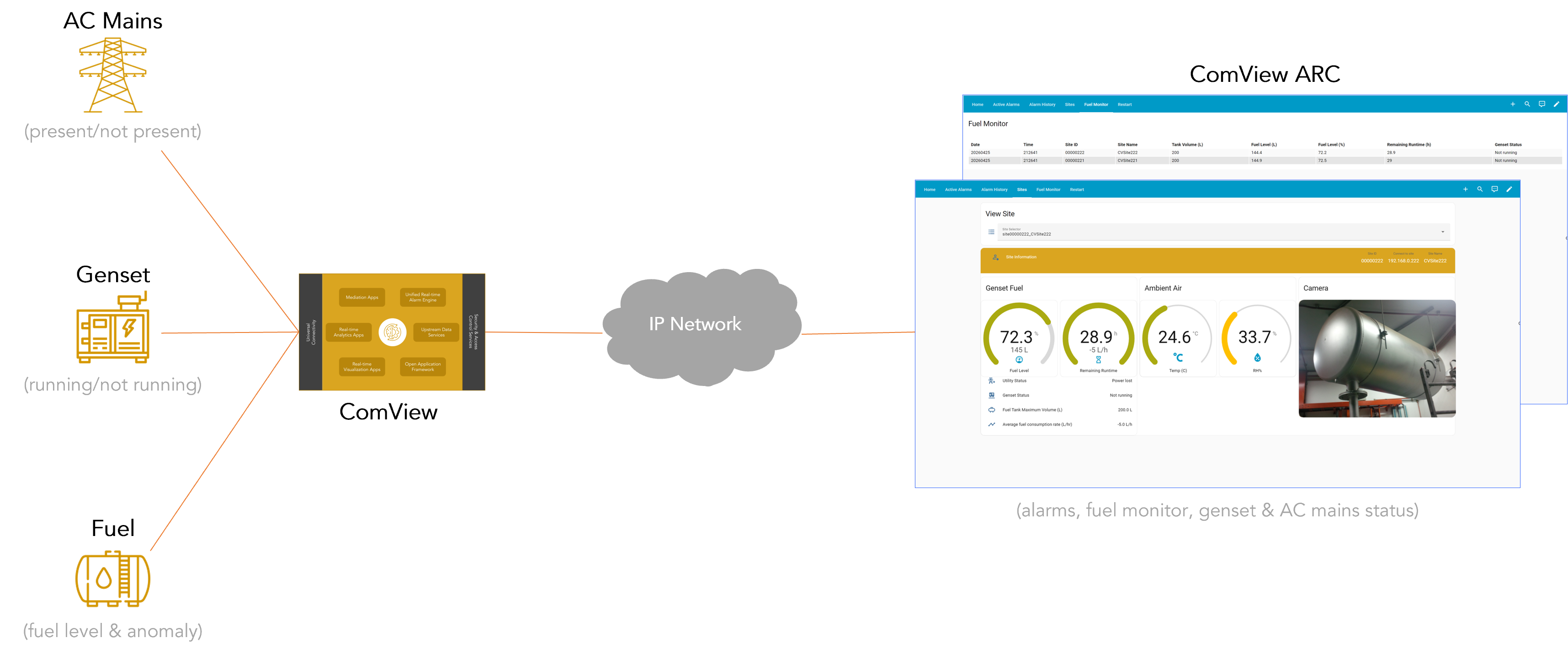
The ComView Solution — Self‑Learning Intelligence at the Fuel Tank
ComView elevates genset fuel monitoring from simple level reporting to a comprehensive, analytics‑driven operational capability. By performing all analysis at the edge, ComView provides immediate detection, accurate predictions, and verifiable accountability for every liter of fuel.
1). Predictive Runtime Intelligence (Self‑Learning Model)
ComView continuously learns the genset’s true fuel consumption rate by analyzing historical run data under real‑world load conditions. This enables:
2). Advanced Fuel Security — Theft, Leak, and Refill Detection
Using sliding‑window averaging and population standard deviation, ComView detects anomalies in fuel level behavior with high accuracy:
3). The Edge Advantage — Real‑Time Detection Without Cloud Delays
ComView performs all statistical processing locally at the site, ensuring:
4). Performance Analytics & High‑Resolution Fuel Records
ComView generates a CSV‑formatted performance record for every fuel‑level reading, creating a high‑resolution dataset for engineering and operational analysis. Each record captures the current date and time, the maximum tank volume, the genset run state, the genset output‑present state, and the AC‑mains‑present state. It also includes the current fuel volume, the instantaneous rate of change, and the long‑term real‑world average and standard‑deviation rates derived from historical runs. This structured dataset provides the foundation for accurate trend analysis, audit‑ready reporting, and upstream integration with enterprise analytics platforms.
5). End‑to‑End Visibility: From Edge Intelligence to Operations Center Awareness
ComView ARC extends the intelligence generated at each site into a unified operational view for the Operations Center. Using the high‑resolution performance analytics produced by the onsite ComView gateway, ARC delivers management‑ready dashboards such as Fuel Monitor and Site View, each tailored to the specific workflows and priorities of Operations teams.
The Fuel Monitor provides a real‑time report of fuel status across the entire install base. Sites are automatically sorted in ascending order of remaining fuel percentage, updating continuously as new readings arrive. This allows Operations teams to instantly identify which locations require immediate refilling and to prioritize dispatch accordingly. Each entry includes the estimated remaining runtime, current fuel volume, and maximum tank capacity — giving teams the information they need to plan refueling schedules with confidence and avoid emergency outages.
The Site View offers a rapid, at‑a‑glance overview of any selected site, presenting key operational indicators such as genset run state, AC‑mains presence, and all fuel‑related metrics. This enables Operations personnel to quickly assess site health, validate alarms, and make informed decisions during power events or refueling operations.
Together, ComView and ComView ARC create a seamless edge‑to‑Operations workflow: real‑time detection at the site, combined with centralized visibility and decision support at the Operations Center. This end‑to‑end integration ensures faster response, better planning, and complete accountability for every fuel‑related event across the network.
ComView elevates genset fuel monitoring from simple level reporting to a comprehensive, analytics‑driven operational capability. By performing all analysis at the edge, ComView provides immediate detection, accurate predictions, and verifiable accountability for every liter of fuel.
1). Predictive Runtime Intelligence (Self‑Learning Model)
ComView continuously learns the genset’s true fuel consumption rate by analyzing historical run data under real‑world load conditions. This enables:
- Accurate Remaining Runtime predictions based on actual consumption patterns
- Precise refueling scheduling to avoid dry‑run outages
- Optimized logistics by eliminating unnecessary or emergency refueling trips
2). Advanced Fuel Security — Theft, Leak, and Refill Detection
Using sliding‑window averaging and population standard deviation, ComView detects anomalies in fuel level behavior with high accuracy:
- Fuel Theft Detection — Identifies unauthorized fuel removal in real time and reports the estimated volume lost, enabling immediate response and accurate expense tracking
- Fuel Leak Detection — Detects slow or sudden leaks early, reducing environmental risk and preventing unexpected runtime loss
- Refill Verification — When a refill occurs, ComView reports the event along with the estimated volume added, allowing Operations to verify vendor delivery quantities before approving invoices
3). The Edge Advantage — Real‑Time Detection Without Cloud Delays
ComView performs all statistical processing locally at the site, ensuring:
- Immediate detection of theft, leaks, and refills
- Continuous monitoring even when backhaul connectivity is down
- High‑resolution event logging without dependency on cloud polling interval
4). Performance Analytics & High‑Resolution Fuel Records
ComView generates a CSV‑formatted performance record for every fuel‑level reading, creating a high‑resolution dataset for engineering and operational analysis. Each record captures the current date and time, the maximum tank volume, the genset run state, the genset output‑present state, and the AC‑mains‑present state. It also includes the current fuel volume, the instantaneous rate of change, and the long‑term real‑world average and standard‑deviation rates derived from historical runs. This structured dataset provides the foundation for accurate trend analysis, audit‑ready reporting, and upstream integration with enterprise analytics platforms.
5). End‑to‑End Visibility: From Edge Intelligence to Operations Center Awareness
ComView ARC extends the intelligence generated at each site into a unified operational view for the Operations Center. Using the high‑resolution performance analytics produced by the onsite ComView gateway, ARC delivers management‑ready dashboards such as Fuel Monitor and Site View, each tailored to the specific workflows and priorities of Operations teams.
The Fuel Monitor provides a real‑time report of fuel status across the entire install base. Sites are automatically sorted in ascending order of remaining fuel percentage, updating continuously as new readings arrive. This allows Operations teams to instantly identify which locations require immediate refilling and to prioritize dispatch accordingly. Each entry includes the estimated remaining runtime, current fuel volume, and maximum tank capacity — giving teams the information they need to plan refueling schedules with confidence and avoid emergency outages.
The Site View offers a rapid, at‑a‑glance overview of any selected site, presenting key operational indicators such as genset run state, AC‑mains presence, and all fuel‑related metrics. This enables Operations personnel to quickly assess site health, validate alarms, and make informed decisions during power events or refueling operations.
Together, ComView and ComView ARC create a seamless edge‑to‑Operations workflow: real‑time detection at the site, combined with centralized visibility and decision support at the Operations Center. This end‑to‑end integration ensures faster response, better planning, and complete accountability for every fuel‑related event across the network.
The Results — Total Fuel Accountability & Operational Predictability
ComView gives Operations teams complete control over genset fuel management:
ComView gives Operations teams complete control over genset fuel management:
- Prevent power outages with accurate, self‑learned runtime predictions
- Verify vendor deliveries using real‑time refill volume estimates
- Control expenses by accounting for every liter lost to theft or leaks
- Reduce OPEX by optimizing refueling schedules and eliminating emergency dispatches
- Strengthen site resilience through continuous, edge‑side monitoring
Who It’s For
- RF and cellular site operators
- Public‑safety communications networks
- Utilities and energy providers
- Transportation and railway communications sites
- Industrial and mining operations
- Any organization relying on genset‑powered remote sites
Edge IT Site Monitoring & Operational Intelligence
unified monitoring & management for edge IT sites
The Challenge — Limited Visibility Across Distributed IT Environments
Across industries, organizations increasingly rely on Edge IT Sites — small but critical environments that house servers, network equipment, storage systems, power distribution units, and supporting infrastructure. These sites may exist in remote corporate branches, field offices, industrial facilities, transportation hubs, utility substations, or RF and cellular locations.
Yet these environments often operate without dedicated onsite staff. Issues such as server failures, unauthorized access, abnormal power conditions, environmental changes, or equipment tampering can go unnoticed until they disrupt operations, compromise security, or cause data loss. Without real‑time visibility and secure remote access, IT and Operations teams are forced into reactive troubleshooting and costly site visits.
Across industries, organizations increasingly rely on Edge IT Sites — small but critical environments that house servers, network equipment, storage systems, power distribution units, and supporting infrastructure. These sites may exist in remote corporate branches, field offices, industrial facilities, transportation hubs, utility substations, or RF and cellular locations.
Yet these environments often operate without dedicated onsite staff. Issues such as server failures, unauthorized access, abnormal power conditions, environmental changes, or equipment tampering can go unnoticed until they disrupt operations, compromise security, or cause data loss. Without real‑time visibility and secure remote access, IT and Operations teams are forced into reactive troubleshooting and costly site visits.
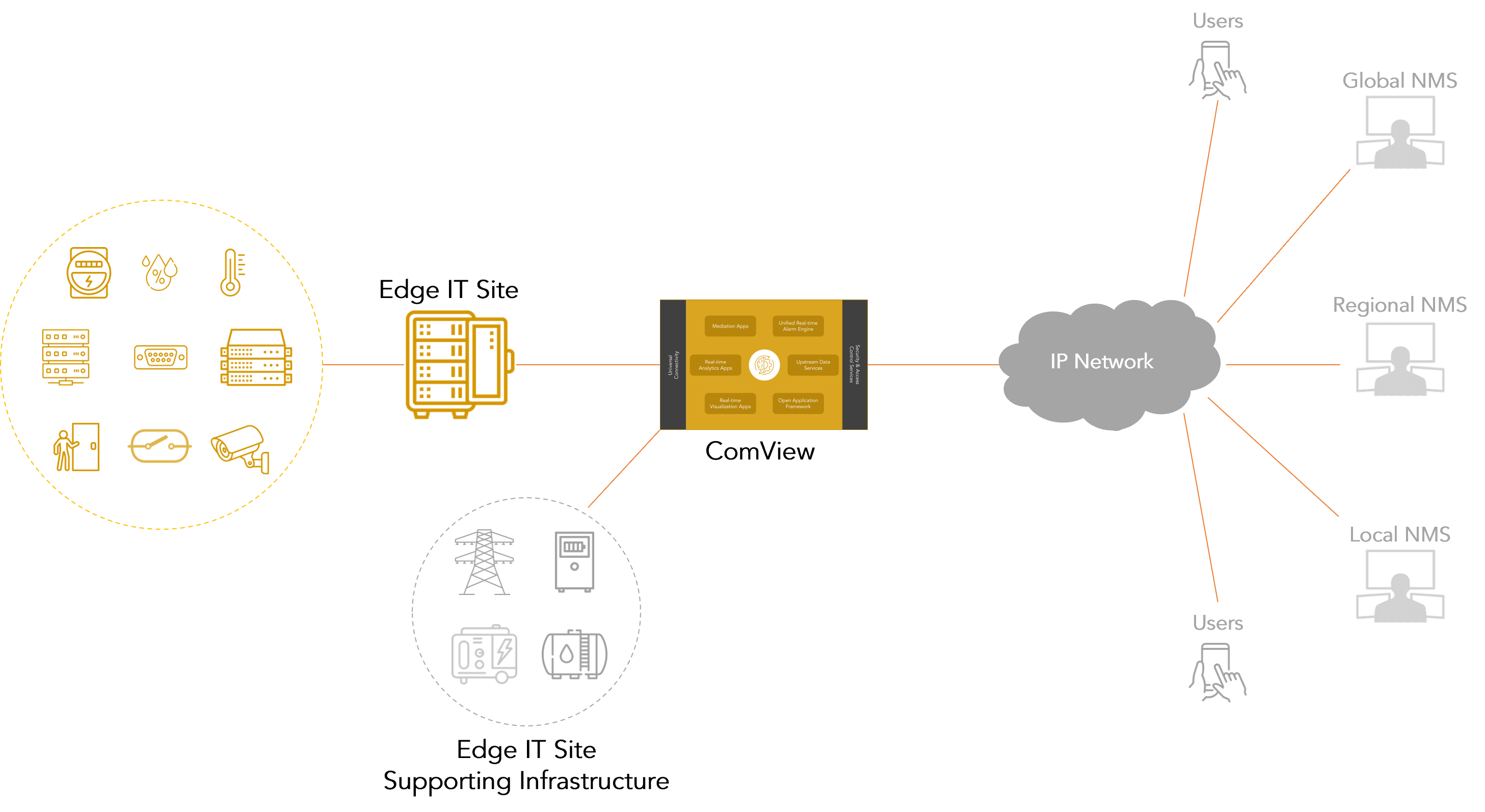
The ComView Solution — Comprehensive Edge Intelligence for IT Infrastructure
ComView provides a unified platform for monitoring, managing, and securing Edge IT Sites. By combining out‑of‑band access, data collection, automation, and environmental intelligence, ComView gives IT, Operations, and Engineering teams the tools they need to maintain uptime, strengthen security, and reduce operational overhead.
1). Secure Out‑of‑Band Access
ComView enables secure, remote console access to servers and network devices, allowing teams to perform emergency administration. This ensures rapid recovery from system failures, misconfigurations, or OS‑level issues without requiring onsite intervention.
2). Serial Data Collection & Event Monitoring
ComView captures serial data streams from servers and equipment, enabling real‑time monitoring of boot diagnostics, system logs, and device‑specific messages. Unusual patterns or error signatures can be flagged immediately, helping teams detect early‑stage failures before they escalate.
3). Task Automation & Script Scheduling
The platform supports user‑defined scripting for routine administrative tasks. Teams can automate log retrieval, configuration checks, system health queries, or security‑related actions such as monitoring for unauthorized login attempts. Scheduled scripts reduce manual workload and ensure consistent operational oversight.
4). Syslog‑NG Collection with Alarm Monitoring
ComView aggregates syslog messages from servers and network devices and applies user‑defined signature matching to trigger alarms. This enables immediate response to critical events such as service failures, authentication anomalies, or hardware faults.
5). SNMP Trap Collection with Alarm Monitoring
SNMP traps from servers, switches, routers, PDUs, and other SNMP‑capable devices are collected and analyzed in real time. User‑defined alarm conditions allow teams to detect equipment failures, link issues, power anomalies, or environmental alerts instantly.
6). Services Monitoring & Application‑Level Oversight
ComView extends its monitoring capabilities through modular apps that allow teams to track the health of application‑specific services running on their servers — including processes such as SQL databases and other mission‑critical workloads. The platform monitors service status, CPU and RAM consumption, and can automatically restart a stopped service to restore functionality without manual intervention. At the system level, ComView also tracks RAM and disk utilization to ensure sufficient capacity is always available for applications to operate reliably.
7). Energy Consumption & Power Quality Monitoring
ComView monitors energy usage at the rack or device level, helping organizations plan capacity, manage costs, and identify abnormal consumption patterns. The platform also tracks power quality metrics — including voltage, frequency, power factor, and harmonics — to ensure safe and stable power delivery to sensitive IT equipment.
8). Remote Power Control & Automated Recovery
ComView enables both interactive and automated control of onsite equipment through its integrated output relays. Teams can remotely power‑cycle servers, reboot unresponsive devices, or activate external systems as part of a scripted recovery workflow. This capability reduces the need for onsite visits and ensures faster restoration of service during fault conditions.
9). Environmental Monitoring for Thermal & Physical Conditions
ComView supports low‑cost digital sensors for granular temperature monitoring, from ambient room conditions to rack‑level and server‑airflow measurements. Additional environmental inputs such as humidity, smoke/fire, and water‑leak sensors help teams detect conditions that could threaten equipment health or uptime.
10). Access Security & Intrusion Awareness
ComView monitors room‑access doors, rack/cabinet doors, and equipment tampering points. Integrated compact cameras provide live video and capture intrusion events at the room or rack level. Images and video clips are automatically emailed to authorized personnel for immediate action, strengthening physical security at remote sites.
ComView provides a unified platform for monitoring, managing, and securing Edge IT Sites. By combining out‑of‑band access, data collection, automation, and environmental intelligence, ComView gives IT, Operations, and Engineering teams the tools they need to maintain uptime, strengthen security, and reduce operational overhead.
1). Secure Out‑of‑Band Access
ComView enables secure, remote console access to servers and network devices, allowing teams to perform emergency administration. This ensures rapid recovery from system failures, misconfigurations, or OS‑level issues without requiring onsite intervention.
2). Serial Data Collection & Event Monitoring
ComView captures serial data streams from servers and equipment, enabling real‑time monitoring of boot diagnostics, system logs, and device‑specific messages. Unusual patterns or error signatures can be flagged immediately, helping teams detect early‑stage failures before they escalate.
3). Task Automation & Script Scheduling
The platform supports user‑defined scripting for routine administrative tasks. Teams can automate log retrieval, configuration checks, system health queries, or security‑related actions such as monitoring for unauthorized login attempts. Scheduled scripts reduce manual workload and ensure consistent operational oversight.
4). Syslog‑NG Collection with Alarm Monitoring
ComView aggregates syslog messages from servers and network devices and applies user‑defined signature matching to trigger alarms. This enables immediate response to critical events such as service failures, authentication anomalies, or hardware faults.
5). SNMP Trap Collection with Alarm Monitoring
SNMP traps from servers, switches, routers, PDUs, and other SNMP‑capable devices are collected and analyzed in real time. User‑defined alarm conditions allow teams to detect equipment failures, link issues, power anomalies, or environmental alerts instantly.
6). Services Monitoring & Application‑Level Oversight
ComView extends its monitoring capabilities through modular apps that allow teams to track the health of application‑specific services running on their servers — including processes such as SQL databases and other mission‑critical workloads. The platform monitors service status, CPU and RAM consumption, and can automatically restart a stopped service to restore functionality without manual intervention. At the system level, ComView also tracks RAM and disk utilization to ensure sufficient capacity is always available for applications to operate reliably.
7). Energy Consumption & Power Quality Monitoring
ComView monitors energy usage at the rack or device level, helping organizations plan capacity, manage costs, and identify abnormal consumption patterns. The platform also tracks power quality metrics — including voltage, frequency, power factor, and harmonics — to ensure safe and stable power delivery to sensitive IT equipment.
8). Remote Power Control & Automated Recovery
ComView enables both interactive and automated control of onsite equipment through its integrated output relays. Teams can remotely power‑cycle servers, reboot unresponsive devices, or activate external systems as part of a scripted recovery workflow. This capability reduces the need for onsite visits and ensures faster restoration of service during fault conditions.
9). Environmental Monitoring for Thermal & Physical Conditions
ComView supports low‑cost digital sensors for granular temperature monitoring, from ambient room conditions to rack‑level and server‑airflow measurements. Additional environmental inputs such as humidity, smoke/fire, and water‑leak sensors help teams detect conditions that could threaten equipment health or uptime.
10). Access Security & Intrusion Awareness
ComView monitors room‑access doors, rack/cabinet doors, and equipment tampering points. Integrated compact cameras provide live video and capture intrusion events at the room or rack level. Images and video clips are automatically emailed to authorized personnel for immediate action, strengthening physical security at remote sites.
The Results — Centralized Control for Distributed IT Operations
ComView transforms Edge IT Sites into fully monitored, secure, and manageable environments:
ComView transforms Edge IT Sites into fully monitored, secure, and manageable environments:
- Reduce unplanned site visits through remote access and automation
- Strengthen security with real‑time intrusion detection and video evidence
- Improve uptime with early detection of system, power, and environmental anomalies
- Optimize energy usage and ensure power quality for sensitive equipment
- Standardize monitoring across all distributed IT locations
- Enable rapid incident response through real‑time alarms and actionable insights
Who It’s For
ComView’s Edge IT Site solution is designed for organizations that operate:
ComView’s Edge IT Site solution is designed for organizations that operate:
- Remote corporate branch IT rooms
- Edge IT Sites
- Micro data centers / edge computing rooms
- Distributed operations facilities
- Industrial and utility control rooms
- Transportation and logistics IT rooms
- Telecom and RF support rooms
- Field office server/network rooms
- Any location with critical IT equipment but no onsite staff
additional information


©CSSTEL 2026
